
 The audacious Long Now Foundation is working to redefine how we see time.
With its massive 10,000-year clock mechanism now functioning inside a mountain in Texas, and the likes of Danny Hillis, Brian Eno and Jeff Bezos engaged, the organization has launched Long Now Labs: The goal is to extend our methods, frameworks, and lenses for long-term thinking.
The call for the first lab in the series “The Book of Time“, and I just submitted a proposal.
Here’s my proposal’s 500-word summary, and a link to my sketches and detailed design.
The Human Identity Foundry:
A global macro-autobiography system to generate evolutionary history
Elements:
- A skeletal Rubric for reporting human identity and interrelationship
- A simple Toolset for self-recording individual lives on durable materials
- A network of Foundries for collating these records to report findings over 10,000+ years
Why:
Humans live in jerks and flurries. We can barely make sense of life before it ends.
Events, experiences, traumas and delights overlap, blurring the bigger picture of who we are as individuals and – perhaps most importantly – how we joined and influenced humanity’s collective identity, well-being, and evolution over time.
Yet historians record all of humanity in terms of gross geopolitical, socioeconomic, or environmental events and trends. Thus recorded, the individual’s life vanishes and, with it, society’s. The evolution of our collective emotion, identity, and relationships is lost.
Instead, the Human Identity Foundry encourages participants to reflect on their lives on a long timeline and record their experiences into an enduring, worldwide archive of humanity’s identity and social history.
How:
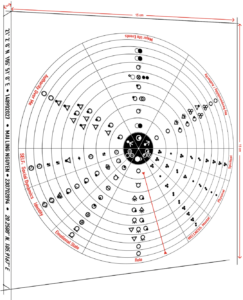
Ritualistic self-accounting of individual life: At birth, each participant is given a phosphor-bronze Tablet – marked by their parent or attending doula with their family name, given name, location and birthdate – for self-recording life events, relationships, and perceived identity.
Every 10 years until death, each participant visits their Regional Foundry.
Using a Font of carbon-steel symbol Stamps and a simple, weight-driven Press, each stamps their Tablet with Symbols representing their past decade of life events, power relationships, and self-perception:
- Home Location
- Principal Partner
- (name & type, e.g. parent, spouse, teacher)
- Societal Role
- (e.g. caregiver, laborer, officer, wright)
- Authorities over me
- (e.g. parent, government, church)
- Entities under my responsibility or authority
- (e.g. family, farm, community)
- Life Events
- (loss or gain of a family member or partner, major injury or cure, communities left or joined)
- Wellness
- (mental, physical, spiritual – each on a scale of Well/OK/Ill)
- Identity
- (Sense of self, emotional state, social dynamics)
As participants die, their final caretakers record time, place, and nature of death and deliver the completed tablets to the Regional Foundry.
Every 100 years, foundry Archivists collate and analyze information from all surrendered tablets, marking findings on a Century Tablet. A Global Foundry analyzes and collates all resulting century records into the Global Archive.
Every 1000 years, the Global Archive collates the prior 10 centuries’ information onto a Millennium Tablet stored in the Global Record.
The Shift: Redefining human history not as a time-series of geopolitical events, but as the evolutionary flow of human identity
This method – a brief, regular, responsibility to record one’s life permanently – offers the reward of, quite literally, making one’s mark on the world.
The protracted timescale forces reflection and encourages accuracy: Which symbols precisely sum up my past decade? Who really was most important?
The Foundry framework distills emergent patterns in self-perception and societal dynamics to reveal a global view of the inexorable evolution of human identity and interrelationship over centuries, millennia, and aeons.
So: Humanity examines – and preserves – our collective Self.